
A history lesson from Melaka, for the wider world
🌏 When the dinner table holds more than just food… it holds faith, culture, and hidden boundaries
In every home, the dinner table is a place where the whole family gathers at least once a day.
But few people notice that there is more on that table than what we eat.
In the modern world, the dinner table has increasingly become filled with phrases like:
- “He can’t eat what we eat”
- “Mom has to cook another pot, because dad can’t eat spicy food”
- “This one is vegetarian, that one is strict about halal”
- “We keep separate kitchens because we’re different religions”
Sometimes, the dinner table that should be a place of love instead becomes a stage of discomfort, fear of overstepping, and quiet misunderstanding.
But did you know that in the past there was once a city with far greater diversity than this,
and yet they used the “food menu” as a tool to resolve conflict —
that city was called Melaka.
🛶 Melaka: the port city that brought religions, languages, and beliefs together in one kitchen
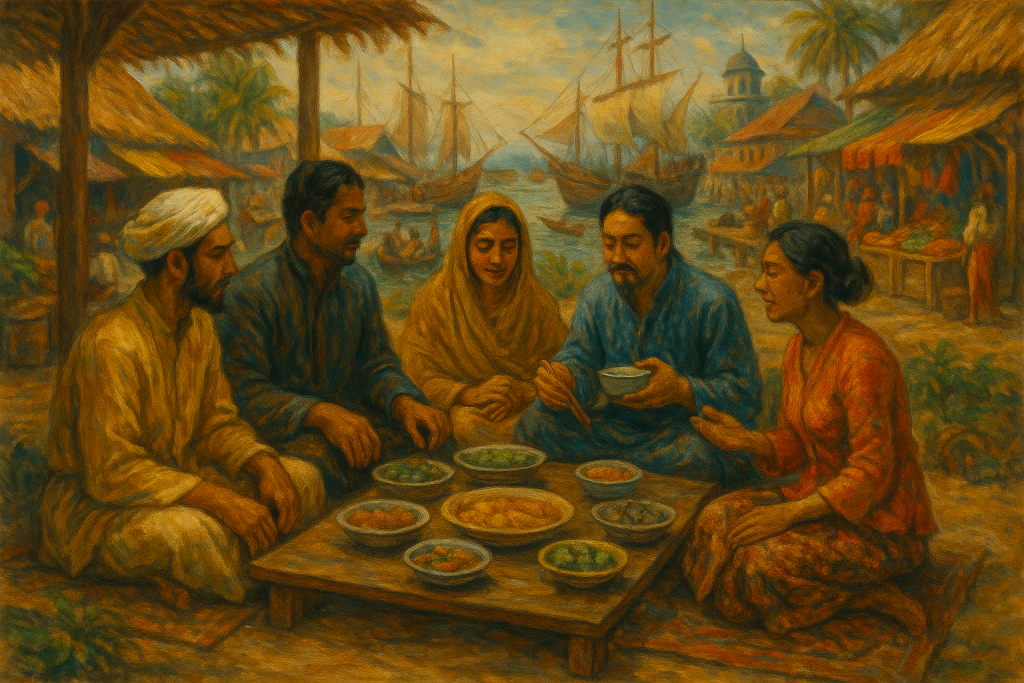
In the 15th–16th centuries, the city of Melaka on the Malay Peninsula was one of the world’s major trading hubs.
Ships from India, China, Arabia, Java, and Europe sailed in to exchange spices, currency, and culture.
The people living in this city did not speak the same language,
did not worship the same God,
did not eat the same food,
and yet they used cooking as a tool for living together.
- Muslims did not eat pork
- Hindus did not eat beef
- Some Buddhists were vegetarian
- Westerners needed their bread, wine, and butter
- The Chinese used high-heat stir-frying and fermentation
- The Malays used coconut milk and local herbs
Despite such differences, they created new dishes that “everyone could eat.”
🍛 Peranakan: the flavor of understanding
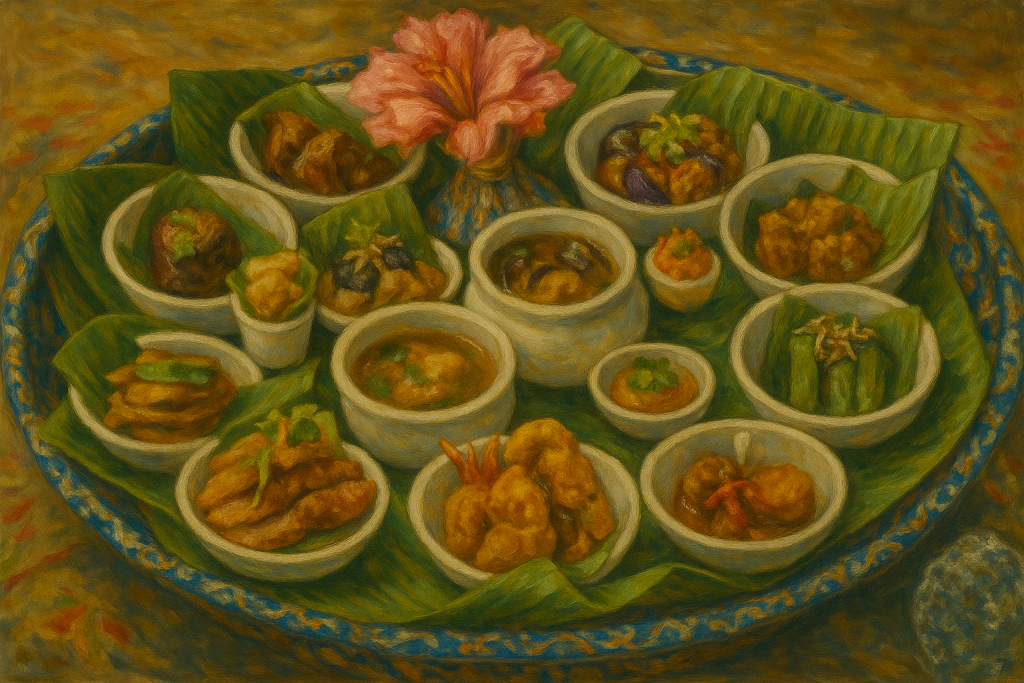
From this kitchen of coexistence in Melaka, a new style of cuisine was born, called Peranakan (or Nyonya), rooted in Chinese-Malay intermarried families, but developed far beyond that origin.
Peranakan food is a representation of a shared design between faith, culture, and taste.
Ingredients that tell the story of multiculturalism:
- Spices from India: coriander seed, cumin, turmeric, simmered to a balanced flavor without using beef
- Chinese stir-frying technique: using oil, fried shallots, fermented bean paste, soy sauce
- Local Malay herbs: lemongrass, kaffir lime leaf, fingerroot, shrimp paste, tamarind juice
- Pickling technique from Portugal and Java: such as acar, a sweet-and-sour pickled vegetable
- Using coconut oil instead of butter to avoid the restrictions of multiple religions
Peranakan dishes, then, are not simply a mix of ingredients, but a shared design at the dinner table,
so that people who “couldn’t eat together before” could sit at the same table once again.
🪑 The dinner table = a stage for cross-cultural negotiation
Peranakan food teaches us that
- The dinner table doesn’t need every dish to be identical
- But there must be room for everyone to have “their own food” that respects their differences
- Sharing a table, then, is not about forcing everyone to eat the same thing
- But it is cooking in a way that lets everyone belong without feeling like an outsider
This isn’t a matter of fashion, but a matter of living together.
🧠 A lesson for today: multiculturalism starts in the kitchen
- In the family
- If the family includes Muslims, Buddhists, and vegetarians, try designing a shared menu — such as a coconut-milk curry without meat
- Use “separate sauces” or “extra side dishes” so everyone can choose according to their own beliefs
- In schools
- Let children learn that eating differently doesn’t mean someone is being difficult
- Use a “share a dish from my home” activity as a bridge of understanding across religions
- In restaurants/hotels
- Design a “multicultural menu” that is safe for many religions
- Explain the ingredients transparently and be ready to adjust as needed
📌 Conclusion
The dinner table of past conflict was resolved by a multicultural menu that respected every difference.
The city of Melaka teaches us that
- Understanding doesn’t have to start in a meeting room
- Living together doesn’t require laws
- It can start from the smallest thing, right in front of us every day — food
All it takes is for us to listen to each other
All it takes is for us to be willing to adjust
All it takes is for us to try to cook something that “everyone can eat”
Peace may begin with just one dish of food… and a table that opens its heart to others.
📚 References:
- Tang, A. (2024). Peranakan Cuisine and Cross-Cultural Harmony.
- Khoo, J. (2016). The Straits Chinese Kitchen.
- Andaya, B. & Andaya, L. (2001). A History of Malaysia.
- UNESCO Memory of the World: Historical Port Cities of the Melaka Straits.
- Department of Cultural Promotion (Thailand). (2020). Peranakan Culinary Wisdom in Thailand and Malaysia
You must be logged in to post a comment.