
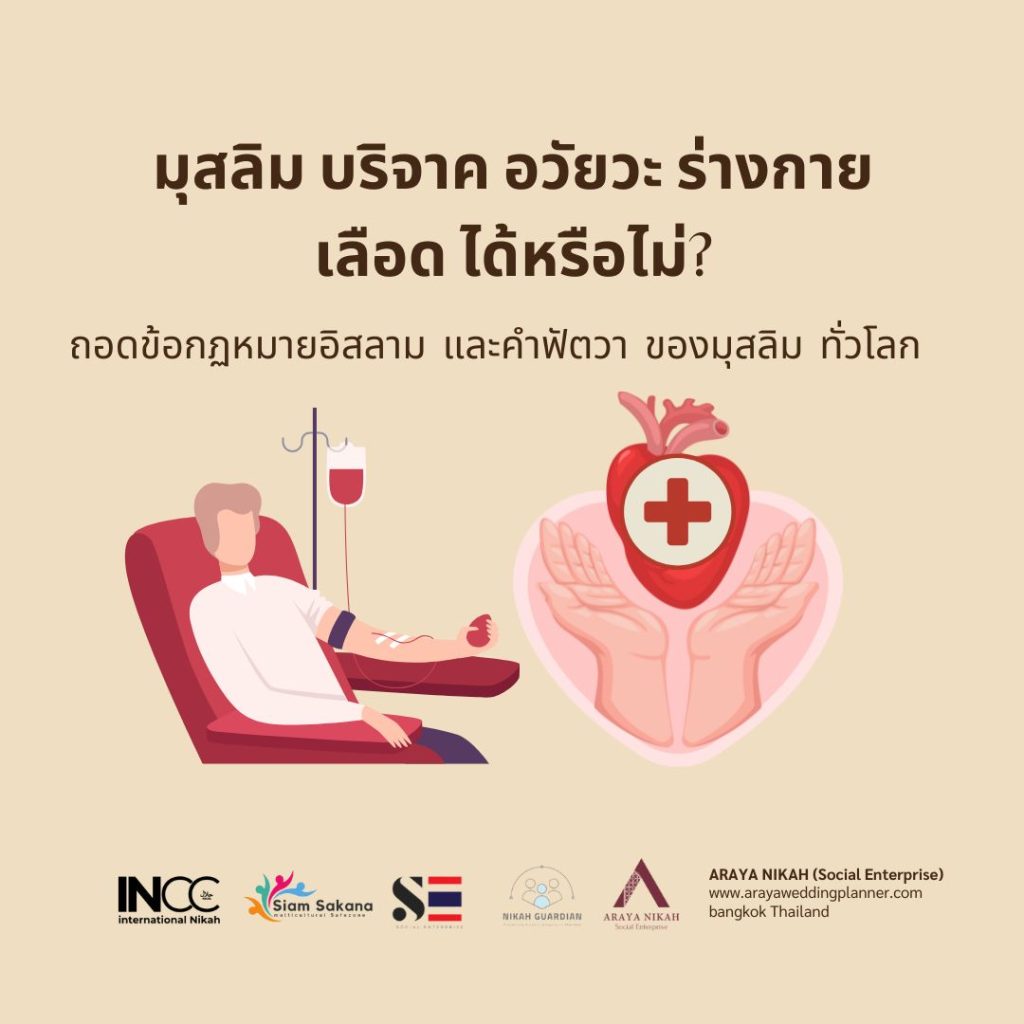
Organ and blood donation in Islam is a topic that has been widely discussed from religious, cultural, and legal perspectives. In this article, we explore viewpoints from various schools of thought in Islam, along with examples from countries where organ and blood donation is widely practiced, so that Thai readers can understand the concept at an international level and apply it themselves.
Introduction
Organ Donation for Muslims: Permissible or Not?
In Islam, donating organs from a deceased person is considered under important conditions, such as the intention to save a life and practices that do not conflict with Shariah principles. Most schools of religious thought accept that Muslims can donate organs, but there are still differences in the details:
- Countries that accept donation: such as Turkey and Egypt, which permit organ donation without restricting the recipient’s religion
- Countries with restrictions: such as Malaysia and Indonesia, where some states may require that the recipient be Muslim only
A document from the Chularajmontri (Sheikh al-Islam) of Thailand (Ruling No. 11/2013) states that donating organs to save a life is considered permissible in situations of great necessity, provided it aligns with medical conditions and clear consent
What Can Muslims Donate?
- Organs that can be donated: heart, liver, kidneys, lungs, corneas, and other tissues
- Blood: accepted across all schools of thought
Who Can Receive a Donation?
- In some countries, donating organs to non-Muslims is still a subject of debate
- Countries with more liberal views, such as Turkey and Iran, allow donation to anyone
- On the other hand, some states in Malaysia require that organs be donated to Muslims only
Perspectives from Different Schools of Thought (Mazhab)
1. Hanafi:
- Organ and blood donation is accepted if it saves a life and there is no other option
- Blood donation in emergency cases is considered permissible
2. Maliki:
- Holds a more conservative view on organ donation from the deceased, emphasizing respect for the body
- Accepts donation in life-saving cases, with the recipient preferably being Muslim
3. Shafi’i:
- Supports organ donation in life-saving cases, if the donor or family consents
- Blood donation is accepted in all cases
4. Hanbali:
- Accepts organ and blood donation in life-saving cases, provided it does not conflict with Shariah
- There must be no commercial exploitation
5. Shia:
- Takes a more open view in some cases, such as considering organ donation to save a life as commendable
Country Examples and Laws Related to Organ Donation
| Country | Organ Donation | Related Law | Notes |
|---|---|---|---|
| Turkey | Permitted | Law No. 2238 on the Harvesting, Storage, and Transplantation of Organs and Tissues (1979) | No restriction on recipient’s religion |
| Egypt | Permitted | Law No. 5 of 2010 on Human Organ Transplantation | Must comply with conditions to prevent human trafficking |
| Iran | Permitted | Law on Transplantation of Organs from Deceased Donors (2000) | Has a government-regulated kidney donation system |
| Malaysia | Permitted | Guidelines by the Ministry of Health and the Department of Islamic Development Malaysia (JAKIM) | Some states require the recipient to be Muslim only |
| Indonesia | Permitted | Law No. 36 of 2009 on Health | Donation requires consent from the donor or family |
| Thailand | Permitted | Ruling No. 11/2013 of the Chularajmontri | No restriction on the recipient’s religion in life-saving cases |
Table of Donation Types
| Type of Donation | Acceptance in Islam | Conditions | Example Countries That Support It |
|---|---|---|---|
| Blood | Accepted | No restriction on the recipient’s religion or status | All countries in the table |
| Organs (e.g., kidney, liver) | Accepted | For saving a life or treating disease; requires consent | Turkey, Egypt, Iran |
| Whole body for medical purposes | Depends on the country | Requires family consent and is used for educational purposes only | Turkey, Thailand |
Thai Muslims Who Wish to Donate Their Body or Organs
Key Steps for Thai Muslims
- State your intention:
- Contact a relevant organization, such as the Thai Red Cross or a hospital that accepts organ donations
- Fill out a form stating your intention to donate organs or your body
- Communicate with your family:
- Explain your reasons and intention to donate
- Share information about the religious principles and benefits of donation, such as saving another person’s life
- Handling the body:
- After donation, the deceased’s body is returned to the family to carry out the funeral according to religious practice
- The washing of the body (غسل الميت) and burial (دفن) will still be carried out fully according to Islamic procedure
- Seeking religious guidance:
- If you have concerns or questions, you should consult a religious scholar (ulama) or a religious leader in your community
Summary
Organ and blood donation in Islam reflects compassion and humanity. Many countries have adopted approaches consistent with their own religion and laws. In Thailand, organ donation is widely supported, without restriction on the recipient’s religion, which is a good example of equality in society.
References:
- Donor Alliance. “Is Organ Donation Permissible for American Muslims?” Accessed December 25, 2024. Link
- Ministry of Health Malaysia, “National Transplant Policy,” Accessed December 25, 2024. Link
- Egyptian Ministry of Health, “Law No. 5 of 2010 on Organ Transplantation,” Accessed December 25, 2024. Link
- Iranian Transplant Registry, “Organ Donation Guidelines,” Accessed December 25, 2024. Link
- Ruling of the Chularajmontri, “Ruling on Organ Donation and the Use of Human Organs” (2013)
You must be logged in to post a comment.