This lesson is part of ARAYA’s learning system
to lay the foundation for understanding truth, knowledge,
and the relationship between human beings and God,
which is the essential basis for conducting nikah and family life in Islam
(1) Absolute truth, or al-Haqq, belongs to Allah alone. He is true reality in the ontological sense — He exists in a state of perfection, without any need to depend on anything else, and at the same time He is the primary ground of existence, the origin of intellect, and the source from which all created things come into being. For this reason, no created thing can be elevated to the level of self-sufficient perfection in its own essence — whether we speak of the universe, nature, human beings, frameworks of understanding, or even what humans call “their own knowledge.” All of these exist in a state of having been granted appearance, not as something able to sustain its own existence. Viewed through a religious lens, all created things exist in a state of faqr — an absolute poverty toward God, not merely material poverty, but a poverty at the most fundamental level of arising, subsisting, and maintaining the state of life itself.
(2) Since only Allah is true reality independently, the truth of created things is a dependent truth. Created things truly exist and can be perceived, but their truth can only stand when considered as something Allah has created and continually sustains at every moment — not as a truth possessing an essence that is self-reliant. This ontological poverty does not diminish the value of created things; on the contrary, it is the unique form of truth belonging to that which exists in the position of a recipient. Therefore, if a human being elevates any created thing to the point of neglecting the truth that it must always rely on God’s sustaining support, he is moving away from the principle of tawhid in his thinking, even if unintentionally.
(3) Allah has opened epistemological channels through which human beings can access truth, through two interlocking planes. The first plane is wahy, or revelation, sent down from above as a guiding light for the prophets. The second plane is ayat, or the signs of truth imprinted upon the natural world, which He sustains. The world of dunya is therefore not merely a backdrop onto which humans may impose any structure of meaning as they please — it is a space that He has made orderly, consistent, and subject to conditions by which human understanding can always be checked. For this reason, the world is not merely something humans observe from outside, but is one of the ways through which God’s truth calls humans to be accountable for what they understand and what they do.
(4) Therefore, truth always precedes the recipient. Human beings did not create truth from within themselves, and do not own it outright — rather, humans are permitted to access truth as recipients, through listening to wahy, contemplating the ayat in the world, interpreting, and responding to what God has opened for them to receive. Since this is the human path to truth, human knowledge cannot be elevated to a closed, unrevisable perfection, because what is perfect is the truth from God, not the perceptual process of a created being that remains under the constraints of language, context, experience, and the ever-present limits of human idrak (comprehension). Learning, interpretation, and response to these signs are therefore not supplementary activities, but the very core of the test in dunya: whether a human being will allow truth to purify him, or will bend truth to serve his own ego.
(5) Din, within this framework, is therefore not merely a system of laws or ritual regulations, but a process of positioning a human being in the correct relationship with God. Attaining the status of a complete Muslim is therefore not merely memorizing doctrine or performing outward rituals, but living with awareness as an ‘abd who submits to his own faqr before God — one who knows that truth is not his own, that knowledge is not his own, and that even the intellectual capacity used for analytical thinking is not his own outright possession. When a human being abandons this awareness, he begins to seize authority and status that are not his, and the deepest religious deviation begins from standing in the wrong position, more than from a mere error of information.
(6) However, human access to truth in the world of dunya does not take place in a space entirely free of interference. Human beings, as created things, cannot claim a state of perfect, error-free perception, entirely free from disturbance. The human state of not being ma’sum (infallible) is therefore not a marginal matter, but part of the condition of his existence as a servant undergoing trial. Closing the door to correction by claiming to have attained an unshakeable yaqin (certainty) confuses “the perfection of truth” with “the imperfection of the human process of perception.” Truth is absolutely precise because it belongs to Allah, but human perception remains the perception of a created being, which is limited and can always be disturbed. For this reason, being open to refinement is not doubting wahy, but humbling oneself before the truth about one’s own condition as a recipient.
(7) The very nature of ayah itself compels human beings to inevitably accept the dimension of interpretation, because an ayah is not the final meaning in itself, but a sign pointing toward a meaning greater than itself — whether that ayah is a verse in scripture or an ordinance in the universe. Human beings must always confront it through reading, interpreting, and placing it within a framework of meaning. Therefore, acknowledging that interpretation can err is not weakening religion, but is the basic ethic of a seeker of knowledge, because it clearly distinguishes “the perfection of al-Haqq” from “the imperfection of human idrak.” And whenever this dividing line is erased, human understanding gradually hardens into an intellectual idol, where people cling to human opinion instead of bowing before the one God who alone is true reality.
(8) The world sustained by Allah’s providence is not a realm of disorderly chaos. Although all things move and change at every moment, they all proceed under sunnatullah, which is God’s set of laws and patterns, characterized by rigor, stability, and reliability. The order of the universe truly exists, and human beings can come to understand it through the process of scientific inquiry. Yet science, within this paradigm, is not the study of nature as a mechanism cut off from the Creator, but the search for the patterns of mercy and wisdom that He has laid down as a foundation. The more deeply human beings are able to decode the complexity of the world, the stronger the testimony that the world does not move or exist by itself, but has been made into a space of learning for human beings by the will of God.
(9) Knowledge, in the Islamic view, is therefore not intellectual property that a human being can possess permanently, but a state of understanding that can survive being tested by truth. The world of reality always functions as a force of resistance against delusion. Attaining knowledge is therefore not merely accumulating and memorizing a set of data, but the process by which human understanding must collide with the truth of the universe and still be able to stand without shattering. Any belief that has never been tested against reality cannot be called complete knowledge, and any knowledge whose claimant refuses to have it examined and criticized will itself transform into another form of rigid delusion, because true knowledge must have the dynamism of life, always ready to be refined, improved, and to yield to a truth that is more correct and more complete.
(10) With this principle in mind, the status of the ‘alim, or the knowledgeable person, should be re-explained carefully — not to undermine the honor or traditional role of the scholar in Islam, but to reveal his true standing as a recipient, a bearer of amanah, and one through whom truth is made to appear. The scholar is not the essence of knowledge, because both his own being and the whole body of learning he holds are subject to the power of being granted, preserved, and reclaimed by Allah. Moreover, what he receives does not come to him bare, but passes through a field of perception, interpretation, and reading that can always err — which makes it all the more necessary for the scholar to humble himself, not less. He has the status of a genuine person only insofar as he is a life that Allah preserves and sustains, not as the owner of a truth that stands by itself.
(11) Given this, the scholar holds the status of a mahall — a locus — through which hikmah (wisdom) is made to appear, under amanah. The profound knowledge he conveys is not a personal patent, but a heavy trust and responsibility that God has entrusted to be made manifest in the world of dunya through his intention and sincerity. The more knowledge is granted to flow through a scholar, the more he must increase his awareness of his own faqr and weakness before Allah. The knowledge and eloquent words he composes today are not ornaments affirming the greatness of his own intellect, but merely empirical evidence that, in that moment, Allah willed for a portion of wisdom to shine through the limitations of one particular human being.
“Understanding this lesson is not intended merely for theoretical knowledge,
but so that human beings may be able to live in the correct relationship with Allah,
which is the core of living life and building a family in Islam”
Yaoharee Latee
บริการ ด้านการแต่งงานอิสลาม ที่น่าสนใจเพิ่มเติม
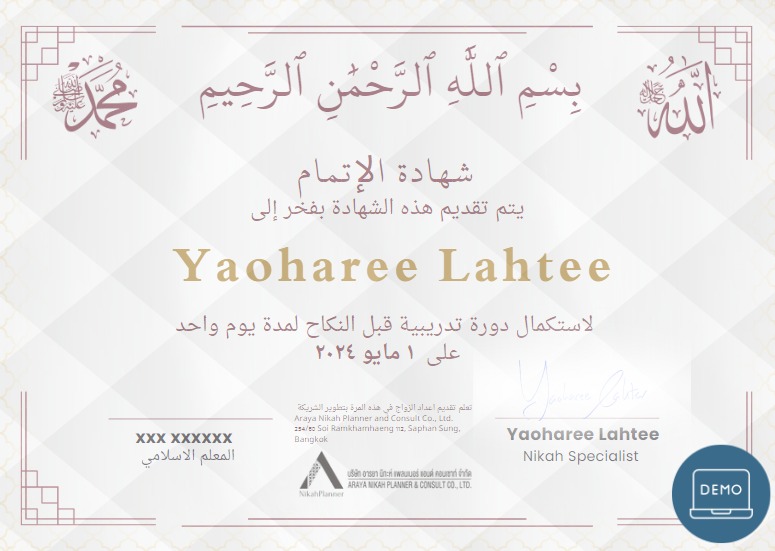
หลักสูตรเรียนรู้ศาสนาอิสลาม และ ใบรับรองการเข้ารับอิสลาม จาก อารยานิกะห์ วิสาหกิจเพื่อสังคม
@arayaweddingplanner.com #muslim #wedding #รักต่างศาสนา #มุสลิม #แต่งงานอิสลาม #พหุวัฒนธรรม #เพื่อนพุทธเราอิสลาม #weddingphoto #ช่างภาพงานแต่ง ♬ เสียงต้นฉบับ – Araya Nikah Planner
You must be logged in to post a comment.