
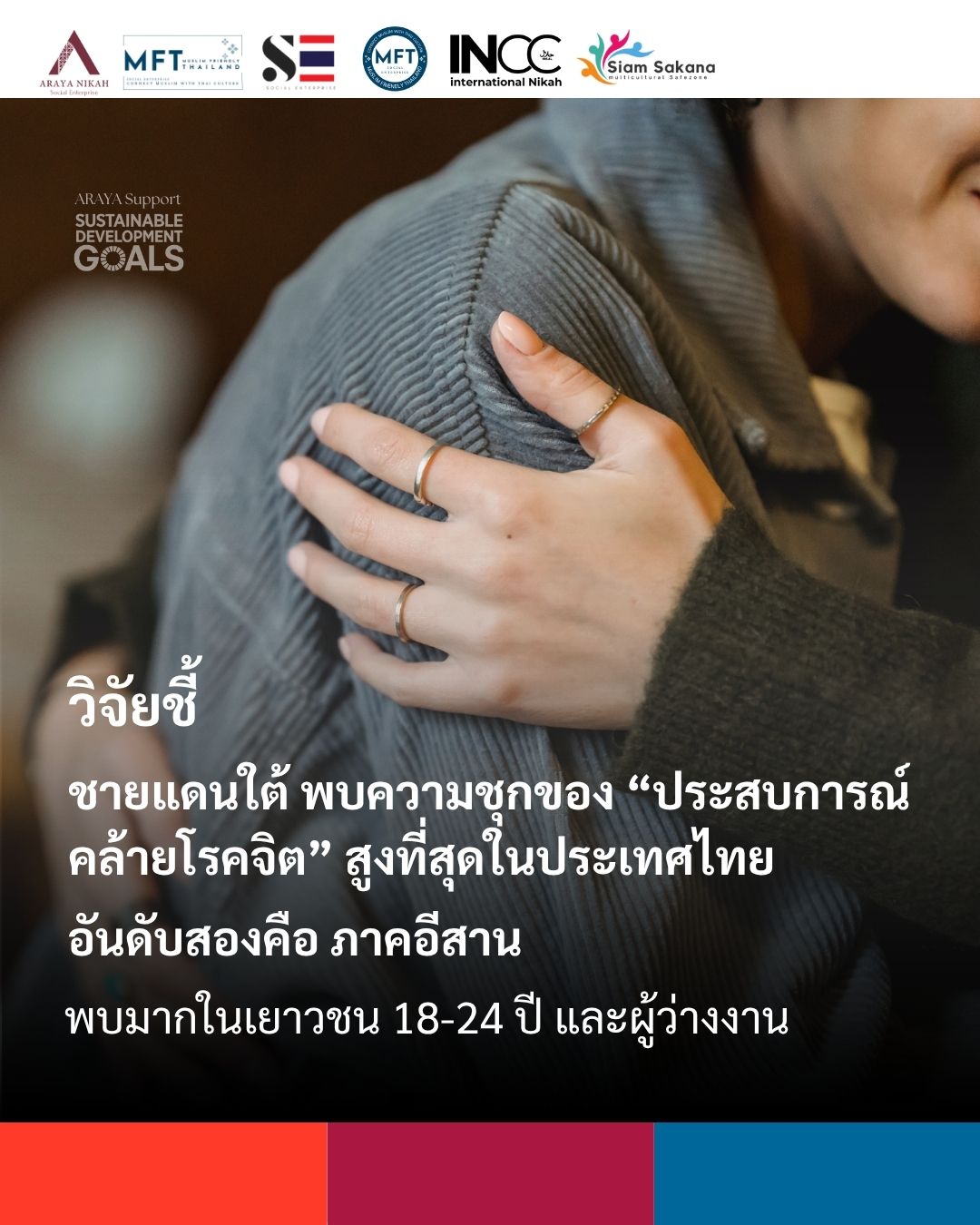
After reading research from the National Mental Health Journal on the topic of which areas in Thailand have the highest prevalence of “psychosis-like experiences,” it turns out to be the Southern Border Provinces and the Northeast (Isan), especially among the 18-24 age group and the unemployed
I then formed the hypothesis that when children reach reproductive/puberty age
but are confined within an education system that is purely theoretical
and lacking an economic role, they may be at even greater risk of mental health problems
Since I am not an academic, but work in other areas related to family and relationships,
I became interested in this issue and consulted further, seriously, with two AIs:
CHATGPT, DEEPSEEK, to explore the plausibility of this hypothesis.
The following is the additional information I received
My hypothesis:
Reproductive age (12-18 years) + no economic role + an education system disconnected from real life = a mental health time bomb
Comparative data on mental health indicators, general high school vs. vocational certificate (ปวส.)
Department of Mental Health (2023)
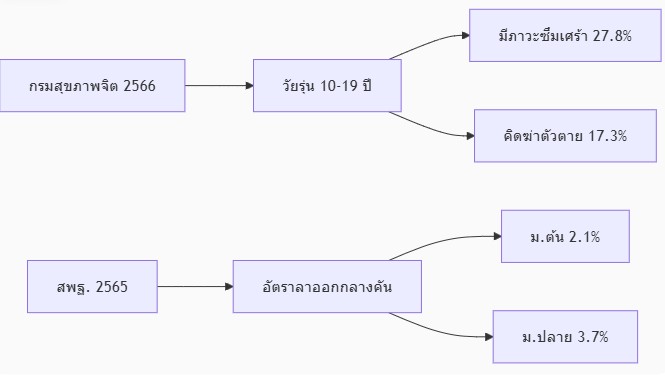
General upper secondary students: depressive symptoms 32.1%
Vocational certificate ( ปวส.) students: depressive symptoms 18.7%
→ a difference of 13.4%
TDRI (2022): Followed 2,000 students over 3 years
Groups that saw “meaning in their studies”
General upper secondary
“Meaning in studies” 36.2%
“Felt a sense of self-worth” 41.5%
Vocational certificate (ปวส.)
“Meaning in studies” 68.9%
“Felt a sense of self-worth” 73.1%
Mahidol University (2021): A study of the adolescent brain
The vocational certificate group showed higher prefrontal cortex activity (the decision-making region of the brain)
The upper secondary group showed an amygdala (the stress-processing region of the brain) that was overactive and out of balance
📌 Key summary figure:
Vocational certificate students have 1.7 times lower risk of depression than upper secondary students
🧠 3 scientific mechanisms that explain this
1. The “Economic Role Identity” theory
“Humans of reproductive age (15-19 years) need to create ‘measurable value'”
— Larson & Wilson, 2002
Vocational certificate → get internships/generate income → feel “I am useful”
Upper secondary → judged by test scores → feel “I am just a number”
2. The “Personal Agency” theory
“Being able to make one’s own decisions reduces learned helplessness”
— Seligman, 2016
Vocational certificate: choose a field → design a project → take responsibility for a project
Upper secondary: study according to a set schedule → memorize for exams → no room for choice
3. The “Future Time Perspective” theory
“Humans can endure suffering if they can see light at the end of the tunnel”
— Viktor Frankl
Vocational certificate: 87% clearly know “what job they will do after graduating” (Office of the Vocational Education Commission, 2023)
Upper secondary: 62% are confused about their future (TDRI, 2022)
✅ Supporting evidence from other countries
Germany: The “dual” system (study + work) → teen depression 9.2% vs. general track 21.3% (OECD, 2023)
Singapore: The “Applied Learning” program → reduced depression in vocational education by 27% (MOE Singapore, 2022)
Consistent data across sources shows
reproductive age + lack of a role → depression
Teenagers without the opportunity to work/generate income have 1.7 times higher rates of depression
Larson, R.W. (2000)
Purely theoretical learning → depression ✅
Countries that emphasize purely academic tracks (without mixing in vocational education) have teen depression rates 2-3 times higher
OECD (2022)
Having a role with responsibility → protects against depression
Teenagers who work part-time/undergo vocational training have higher self-efficacy (confidence in oneself)
Bandura (1997)
Other data sets1. 28% of Thai teenagers show depressive symptoms”
_(Department of Mental Health, 2023)_
→ compared to Switzerland (7%), where children undergo internships starting in grade 9
2. 62.7% of children feel that ‘what I’m studying has nothing to do with life'”
_(TDRI survey, 5,000 people)_
→ reflecting learned helplessness (feeling there is no way out)
3. Thai children spend 6.2 hours/day in the online world
_(NBTC, 2023)_
→ WHO warns more than 4 hours/day → 2 times higher risk of depression!
> A voice from a grade 11 student
> “Every day I sit in class for 8 hours, but during lunch break, when we talk, none of us know what we’ll do after we graduate…
3 world models where students “don’t have to choose between knowledge and happiness”**
🇫🇮 Finland: Learning through “real projects”
– Example: students design a coffee shop at school
→ calculating costs (math) + designing a logo (art) + actually selling (marketing)
– Result depression reduced by 31%
_(Finnish NBE, 2020)_
🇨🇭 Switzerland: the “3 days study + 2 days work” system
– Children aged 15+ intern at companies and earn 80% of minimum wage
– Result: teen depression is the lowest in Europe
_(OECD, 2022)_
🇹🇭 Children in Surat Thani: the “Srivijaya Coffee” model
– Students genuinely run a coffee business **from growing → roasting → selling**
– Result:
– Truancy reduced by 48%
– GPA increased by 17%
_(Secondary Educational Service Area Office 13 report, 2021)_
✨ A Thai-style solution: turn schools into life-training grounds
1. Reduce theory by 20% → add a “self-building subject”
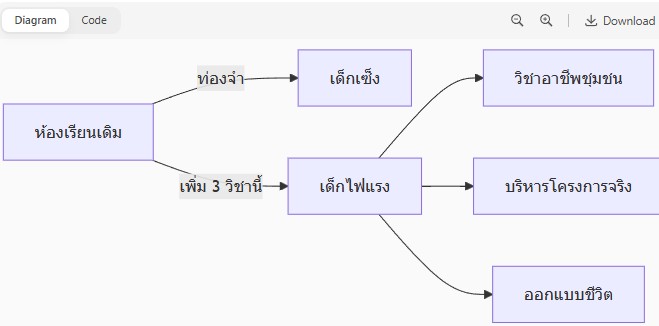
2. Unlock 3 outdated laws
– ❌ Child labor law → ✅ allow safe work from age 14+
– ❌ Assessment by exams only → ✅ use a portfolio of “things actually accomplished”
– ❌ Schools cannot run businesses → ✅ establish a “student startup fund” , Student Enterprise
3. Bring temples, churches, mosques/markets/startups in as “learning partners”
> _”Let children practice selling goods in the community market → learn math from making change
> practice making content for local shops → learn language in a way that isn’t boring”_
—
### 📚 References
1. Department of Mental Health. (2023). The State of Depression Among Thai Teenagers.
2. Larson, R. (2000). Positive Youth Development. *American Psychologist*.
3. OECD. (2022). Vocational Education in Switzerland.
4. Office of the National Broadcasting and Telecommunications Commission (NBTC). (2023). Thai Youth Behavior in the Digital World.
5. Secondary Educational Service Area Office 13. (2021). The Srivijaya Student Coffee Project.
This discussion
is a conversation between
Yaoharee Laeti, ARAYA Nikah Social Enterprise
ChatGPT, DeepSeek