
Unpacking the Causes: Gratitude According to Islamic Principles
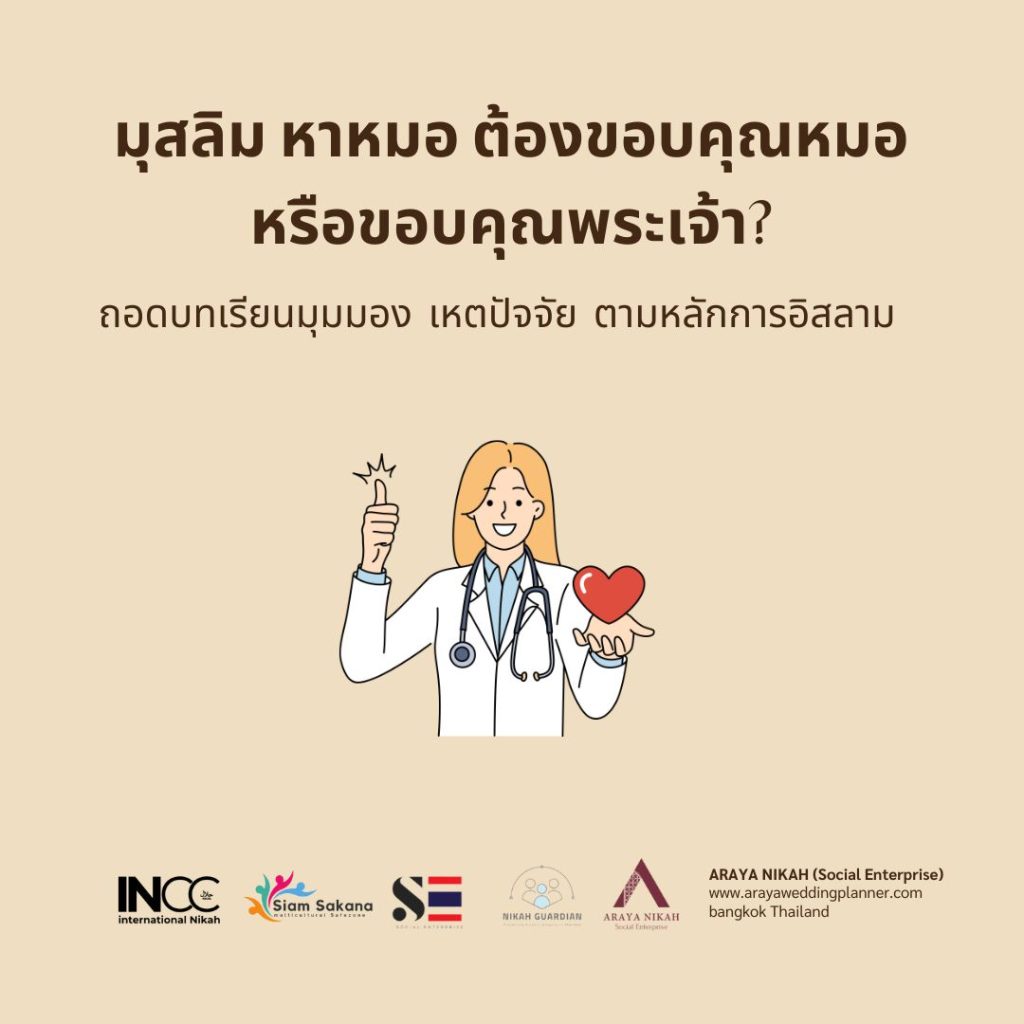
When a Muslim sees a doctor and recovers, and the Muslim thanks God, a question may arise: what about the doctor who provided the treatment — why doesn’t he receive that thanks? Let’s trace this relationship together and work out where the issue actually lies. This may be difficult to understand for new Muslims or non-Muslims, but let’s try to gradually understand what the core Muslim mindset is, before considering these matters in every dimension — which may need to start with an attempt to understand the truth that Muslims hold to.
The Truth Within the Muslim Framework, Regarding One’s Own Body
The truth that Muslims hold to rests on the principle that the body and soul, together with the orderly universe — from the tiny blood vessels around the heart to the orbits and eventual demise of stars, all corresponding and interrelated endlessly and perfectly — cannot arise by themselves or by chance. Just as a mobile phone or a building of great complexity cannot come into being on its own, but comes from a maker, so too all of this comes from God, who alone holds exclusive power beyond any state of limitation, beyond birth and decay, and beyond time itself.
Muslims hold to the truth that human beings were created as vicegerents on earth, in reverence toward Him. One expression of that reverence is to take care of one’s body and mind so that they remain healthy and at peace, so that one may carry out good deeds and mercy — toward oneself, toward society, and toward one’s family — for as long as God wills. Therefore, taking care of the body and mind is a duty for every Muslim.
With that said, what are the causes, and how do they connect to gratitude, that may lead a Muslim to seemingly forget to thank people? We can consider this further through the following principles of causation.
Cause (sabab), Means (waseela), and Effect, According to Islamic Principles
Understanding the principle of cause, factor, and effect according to the truth Muslims hold to helps us understand the overall picture and the mindset behind the various decisions Muslims make, which can be quite diverse. Where worldly and scientific cause and effect are concerned, Islamic philosophy treats this as a secondary cause. In Islamic principle, the view of cause and effect is divided into: the primary cause (sabab ra’eesi) — the secondary cause (sabab thanawi) — and the means (waseela), where the causal factors include both what a person can and cannot control.
For example, when a person falls ill and decides to see a doctor, seeing the doctor is the secondary cause (sabab thanawi) that we choose and can control. And when the doctor prescribes the appropriate medicine, taking that medicine is the means (waseela) that assists the treatment process. But the fact that the outcome is a success arises from the primary cause (sabab ra’eesi) — the mercy of God — because in truth we cannot control the outcome. We may see a doctor and still not recover, due to other secondary factors connected from the very beginning, all bound together leading to the present result as decreed by Allah, in the view of a Muslim.
Understanding the role of each part in this process helps a Muslim distinguish the role and importance of the “secondary cause” and the “primary cause” in a more balanced way.
However, understanding that the ultimate cause and outcome belong exclusively to God does not mean there is no need to give thanks along the way — that would be a misunderstanding that can occur within Muslim society itself. For even though it is not the primary cause and effect, the help and kindness received are real, and a good Muslim must be mindful of them.
Do Thank the Doctor (the Means) Who Brought a Good Outcome
These principles of cause and effect are in no way a prohibition on honoring and thanking the various things connected to the outcomes around us. Muslims are taught to be people of honor who give honor, to know how to give thanks, and to always maintain good manners. There is no prohibition whatsoever on a Muslim thanking the doctor and thanking God at the same time.
Giving thanks and giving honor is something a Muslim should practice, even though the final outcome of treatment ultimately comes from God’s decree, and even though God asks us to let go and not try to control it, but to entrust the outcome calmly. Even so, a Muslim must still connect with and know how to thank those involved in providing help in every way, because according to Islamic principle, expressing gratitude toward fellow human beings reflects mercy and the acceptance of constructive relationships in society. Socially, giving thanks and honor to those who took part in our success shows humility and gives value to other human beings, which is a virtue promoted in Islam. Failing to give thanks makes us arrogant, and arrogance is what brings us close to Satan.
“Thank you, doctor, for helping my daughter recover fully. May God reward you and your family for your kindness.”
A Muslim
Conclusion: The Truth That Muslims Are Asked to Let Go of the Outcome, While Holding Fast to the Causes They Cannot Control
Although the philosophy of cause and effect according to the truth of Islam may seem harder to grasp than ordinary causation, it holds something deeply important for humankind. Within the Muslim mindset, the essential duty is to accept and let go of outcomes that lie beyond one’s control, while placing importance on seeking out the appropriate secondary cause (sabab thanawi) and means (waseela) — such as seeing a doctor or seeking advice from an expert — as part of one’s worship of God, then letting go of the outcome of treatment and accepting its result calmly.
Muslims believe these actions are part of the responsibility they owe to their own life and body, while at the same time holding faith and trust in God that the outcome that occurs is the best one, in the way God has decreed.
Giving thanks and giving honor is something a Muslim should practice, even though the final outcome ultimately comes from God’s decree, and even though God asks us to let it go — yet expressing gratitude to the doctor or to those involved also shows mercy and the acceptance of constructive relationships in society.
You must be logged in to post a comment.