
📝 Writing a Divorce Letter
The starting point of a fair process under Islamic principles
“Divorce is not an easy choice, but sometimes it is the safest and most compassionate way out for ourselves and others.”
— ARAYA Nikah Social Enterprise
The Context of Muslim Society in Thailand
At present, the divorce system for Muslims in Thailand still lacks clear, comprehensive, and easily understood standard practices for everyone involved — whether at the community level, the family level, or even in court proceedings. In many cases, one party wishes to divorce, but the other party does not understand the process, lacks a channel of communication, or relies only on spoken words and emotion, which leads to prolonged conflict or later litigation.
To address this problem, writing a divorce letter is a safe, documented, and fair starting point in line with Islamic principles, and it can be used both at the initial mediation stage and when entering an arbitration process or an Islamic court.
What Is a Divorce Letter?
A “divorce letter” is a document written by one party in a marriage to formally express the intention to divorce. It states basic information, the reasons, the proposed approach, and polite wording, with the following goals:
- To clearly express that divorce is a choice reached after mindful consideration
- To help the other party, the family, or an advisor understand the real reasons
- To serve as evidence or supporting material in religious and legal proceedings
- To prevent misunderstanding, denial of responsibility, or later accusations
❗ Note:
A divorce letter is not itself a complete religious divorce
but rather the beginning of a process that is safe and backed by documentation
Why Should the Husband Also Write a Divorce Letter?
Even though under Islamic principles the husband has the right to pronounce talaq on his own without needing permission from his wife or family, in practice:
- If talaq is pronounced without witnesses or documentation → he may be accused of divorcing unjustly
- If the wife is not formally notified → this may lead to disputes over maintenance, iddah expenses, or children’s rights
- If there is no evidence of the divorce → legal problems may arise, such as issues with children’s registration, remarriage, or unknowingly having two spouses
Therefore, a husband’s divorce letter is an important tool for demonstrating responsibility, clarity, and transparency in a religiously compliant divorce.
Key Components of a Divorce Letter
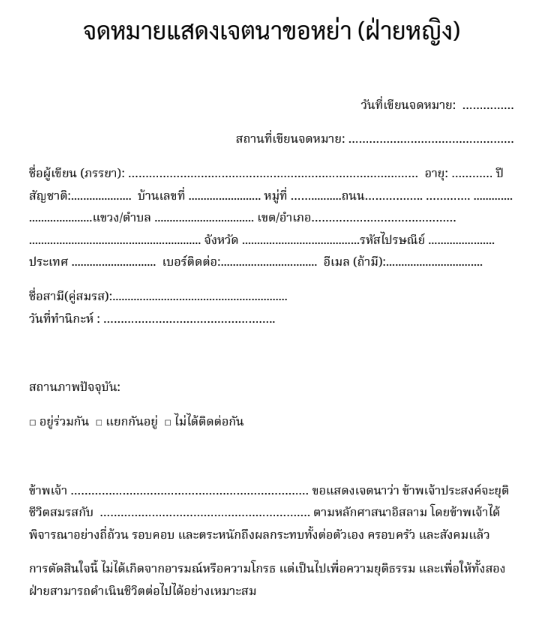
✅ For the Wife (the party requesting divorce)
- Date and place the letter is written
- Personal information of herself and her husband
- A clear intention to request divorce
- Reasons for requesting divorce, such as neglect, abuse, religious conflict, etc.
- The proposed approach:
- Requesting that the husband pronounce talaq amicably
- If talaq is not pronounced → requesting to enter the khula process or file for faskh
- A record of efforts made to resolve the problem, such as discussions or mediation
- Goodwill toward the former spouse
- Signature and witnesses (if any)
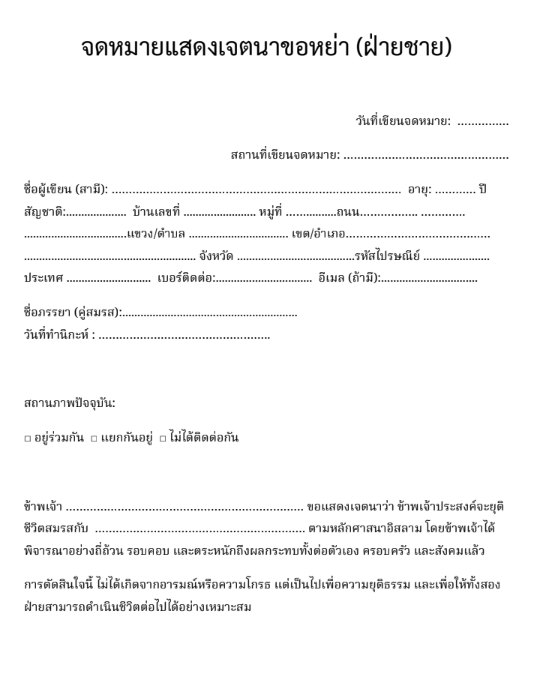
✅ For the Husband (the party wishing to divorce)
- Date and place the letter is written
- Personal information of himself and his wife
- A clear intention to divorce
- Reasons for the decision, such as chronic conflict, a failed marriage, etc.
- The plan following the divorce, such as:
- Being ready to pronounce talaq in person
- Taking responsibility for maintenance / children / iddah expenses
- Goodwill or a du’a
- Signature and witnesses (if any)
What to Do After Writing the Letter?
- Notify the spouse of the letter clearly and politely
- Inform the families or close elders on both sides so they understand the situation and may be able to help mediate
- Keep a copy safely for future use if it must be submitted to religious/legal authorities
- Enter the arbitration process / mosque / Islamic committee / court if the agreement does not succeed
Grounds That Can Support a Divorce Letter (referencing Islamic courts in Thailand, Malaysia, and Singapore)
- One party commits a serious moral offense (such as zina)
- Repeated physical or emotional abuse
- Abandonment of married life for more than 4 months
- Failure to fulfill husband’s/wife’s duties
- Domestic violence
- Obstruction of religious practice
- Severe mental or physical health problems
- Drug or alcohol addiction
- Long-term imprisonment
- Conflict of faith
- Irretrievable breakdown of the marriage, etc.
✅ These grounds can be used in the khula / faskh process and in Islamic courts in all three countries
Summary: A Divorce Letter = A Mindful and Safe Beginning
Divorce is a delicate matter, and Islam has laid out a path that clearly contains both compassion and justice. Writing a divorce letter is the beginning of a dignified divorce process, backed by documentation, and protecting the rights of everyone involved — especially in an era when spoken words alone are no longer sufficient for legal or religious recognition.
One letter may help avoid major problems in the future
and may be the starting point of “peace” after parting with dignity.
✒️ Compiled by
ARAYA Nikah Social Enterprise
A developer of marriage and family systems for Muslims in a multicultural society
📍 Website: www.arayaweddingplanner.com
📩 Email: arayawedding@gmail.com


You must be logged in to post a comment.