
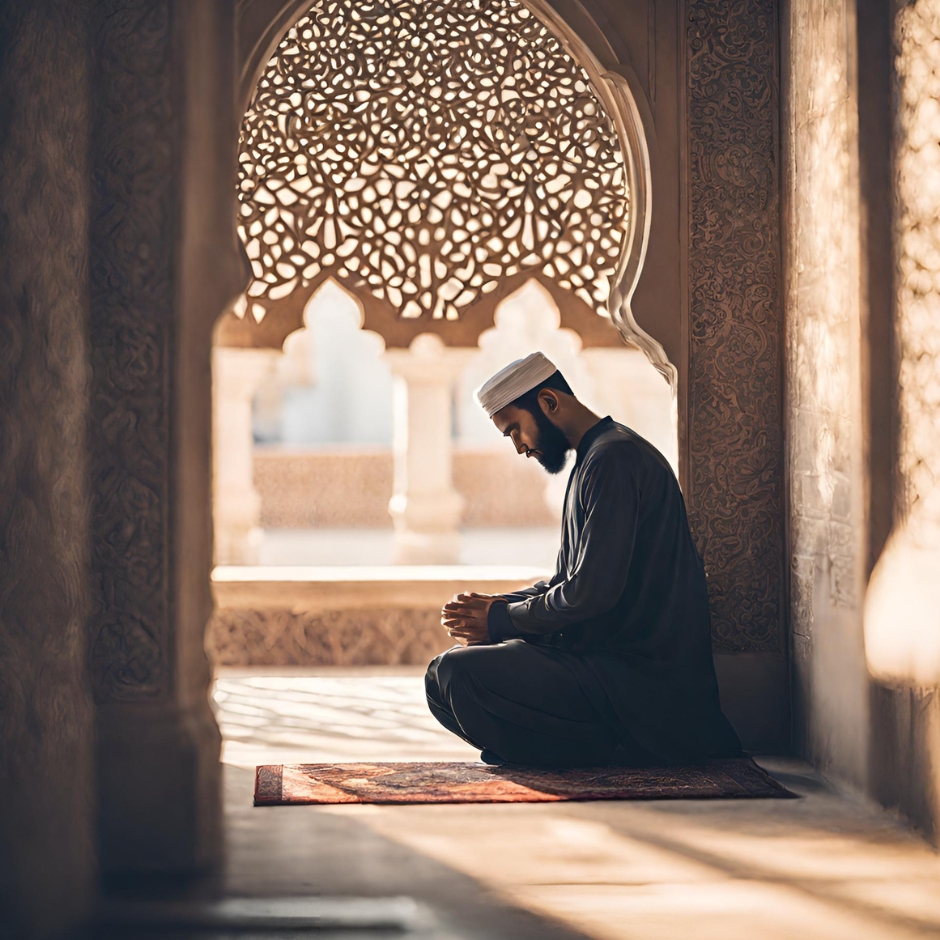
Prayer (salah), from the perspective of YAOHAREE LAHTEE, Nikah Specialist
Every day, or over the course of a lifetime, we all have to deal with many things beyond our control. We cannot control other people’s actions, we cannot control circumstances, we cannot even fully control ourselves or our own thoughts. Often, when the world does not go the way we want, when life does not go the way we want, various wounds accumulate over time at each stage of life.
Peace is something valuable and important for every human being of every race and origin. Waking up in peace and going to sleep in peace, beyond adjusting one’s mood, also has ongoing effects on physical health, family relationships, life, and even work performance or personal and social development.
Peace is something valuable, and the art of being Muslim lies in using prayer as a tool, whether consciously or unconsciously.
Prayer is an activity that can be scheduled at a suitable time, 3-10 minutes, depending on the situation, with timing that can be adjusted or made up. Prayer is a flexible tool that can be adapted to life — even an anesthesiologist or a pilot can manage it, depending on planning.
What Steps Does Prayer Ask a Person to Go Through?
1. Cleanliness and mindful awareness while cleaning. The art of the ablution (wudu) asks us to set our intention and be aware of what we are doing, following a set order to make sure each step covers every important part. A person who performs wudu calmly will be mindful and aware, doing each thing in sequence. Washing the face, eyes, and other parts of the body not only helps prevent heat build-up, which carries health risks especially in the hot season, but also refreshes the person performing wudu — think of a time you were troubled; washing your face and eyes alone already helps a great deal, as well as reducing drowsiness or similar states that may occur at times unsuited to sleep.
2. Reviewing morality. Part of the prayer process is reciting and reviewing the Quran, the word of God reminding people to do good for themselves and for the community, across every nation and faith and ethnicity, and reminding them that life in this world is not long enough to hold onto, so one should hasten to do good toward one another, to store up provisions for the next stage ahead.
3. Movement. The prayer process also asks the Muslim to move the body and stretch appropriately. The spacing between each stretch across the prayer times helps avoid sitting too long during the day, and exercises the knee joints and various muscles as appropriate. In addition, during prostration (sujud), Muslims experience a state of connecting with the earth, and become aware of how small they are compared to the world and this universe, and that there is no need to carry more than one is able to bear.
4. Knowing yourself. Once the prayer is finished, this becomes the moment a Muslim has the right to make supplication (dua). In Islam, every Muslim is aware that whether a request is granted or not, they themselves must also take action, as stated in the following ayah of the Quran
“…Indeed, Allah will not change the condition of a people until they change what is in themselves…”
Ar-Ra’d: 11
No human can know whether it will be granted or not, as this is Allah’s exclusive right, but the moment a Muslim makes dua, they are speaking with their own subconscious, talking quietly with themselves about what they truly want. Many times we quarrel with family over small matters, but when we make dua, we end up asking for our family’s health, happiness, and even matters of money that once seemed important barely come up — mostly we ask only that those around us be at peace. Making these supplications brings the subconscious and the conscious mind of the Muslim into alignment, without conflict, and helps maintain a grounded, stable personality, protecting against psychological issues, especially those arising from the subconscious and conscious mind being out of sync. Making dua helps a Muslim know themselves the instant they ask, and if this asking becomes more disciplined and structured, it also helps the Muslim develop their own personality more appropriately.
5. Letting go. Having made their request, every Muslim comes to realize that the right to grant belongs to Allah. A Muslim must let go of the outcome of their request and place trust in Allah (tawakkul) — that is, the Muslim realizes that no matter how much they want something, in the end they cannot control it; all they can do is their best, and the rest, the outcome, is not something within their duty or control. This step helps the Muslim let go and return control of the whole world, and control of life, back to Allah, and once that control is released, the peace that comes from knowing oneself and letting go of things takes its place.
6. Stillness. In the final part, a Muslim who has time may sit quietly a while longer to remember Allah, gathering scattered focus into stillness, or may simply get up to continue with their duties — this is left for each Muslim to design their own prayer around.
All of this happens within 3-10 minutes each time.
Being clean, stretching the body, reviewing one’s morals, knowing oneself, and letting go of the world for a while to dwell in peace — this is something Islam asks every Muslim to do at least five times a day, because Islam gives great importance to peace, and a person at peace goes on to create good for themselves, their family, and society. That is the reason Muslims give such importance to prayer.
I hope this sharing will be useful to fellow members.
You must be logged in to post a comment.