
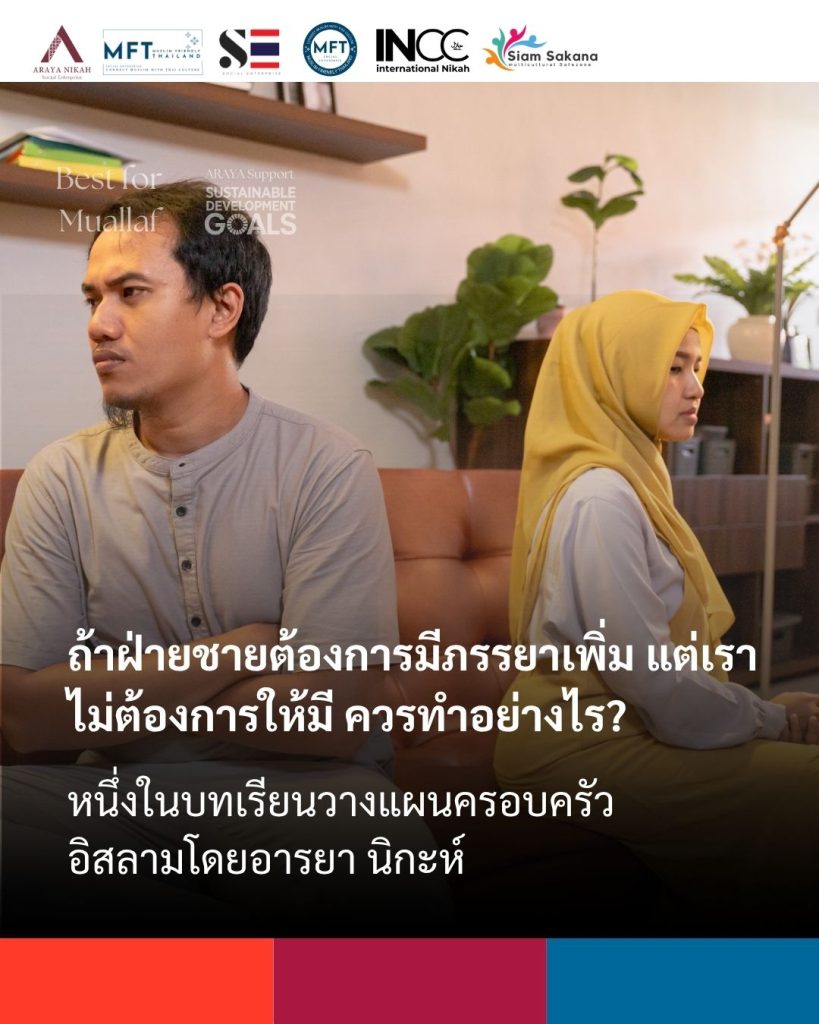
If a husband wants to take another wife
And we don’t want that to happen… what should be done?
One of the lessons on Islamic family planning, by ARAYA Nikah
How “Islamic family” differs across the diversity of the world’s Muslim cultures
In Islam, the principles concerning marriage and family have a clear position: the institution of the family must be built on the foundation of love, mercy, justice, and responsibility.
In reality, however, the concept of family life among Muslims varies noticeably from place to place, rooted in:
- The diversity of religious schools of thought (madhhabs)
- Local beliefs and community values
- Gender roles in society, and
- The legal systems each country uses to handle family matters
A topic rarely discussed before marriage, but one that creates big problems afterward
One of the questions that often creates discomfort for Muslim couples is:
“If the husband wants to take another wife, but the wife doesn’t want that at all… what should be done?”
This question isn’t just about rights — it’s about faith, feelings, security, and fairness.
If this isn’t discussed before marriage, the question can become the root cause of:
- Mistrust
- Emotional harm
- Or divorce that leaves lasting wounds on both the wife and the children
At ARAYA Nikah, we therefore recommend discussing this openly and honestly before marriage, and setting out a “shared marriage agreement” together to prevent future problems.
Does the husband need the wife’s permission?
This question does not have a single answer that applies to every Muslim family.
That’s because religious scholars (ulama) hold differing views depending on their school of thought, and the context of each country differs as well.
- Some views hold that if a man is able to fulfill the requirement of justice, he may take another wife without needing permission from the first wife
- Others hold that deciding to remarry without the first wife’s consent or even without informing her may be seen as a violation of the spouse’s heart, and could lead to unintentional injustice
In some countries: laws are designed to prevent problems
For example, in Malaysia, Indonesia, Morocco, or Jordan, laws related to additional marriages have been systematically designed, generally following an approach such as:
- The husband must submit a petition to the religious court or relevant authority
- The court will consider his ability to support the family, fairness, and the potential impact on the existing wife and children
- Some countries stipulate that the first wife has the right to object, or must at least be notified in advance
These laws do not contradict religious principle — rather, they are a social mechanism that helps ensure the exercise of this Islamic right happens responsibly and without causing unnecessary pain.
For Thailand
In Thailand, even though Muslim society is open-minded on many religious matters,
under the civil legal system, only one marriage can be registered at a time.
As a result:
- A second wife under religious rites cannot be registered under Thai law
- And children born to the second wife are legally considered children born out of wedlock
This leads to several consequences, such as:
- The second wife has no right to property or inheritance if there is no will
- The children cannot automatically use the father’s surname, and may need to prove paternity legally
- Access to welfare benefits, social security, or citizenship may become complicated
- And socially, the wife and children may feel that they are living “in the shadow” of the first family
Taking another wife without carefully planning for the legal and broader consequences can therefore create unintended injustice.
Even though the law of this world may not be able to punish it,
Islam teaches clearly that in the akhirah (the hereafter),
every neglect of fairness — especially toward those who are weaker, such as wives and children — is something one must answer for in full detail.
Prevention is better than cure: a universal principle aligned with Islam
ARAYA’s approach is preventive family planning, which is consistent with universal concepts of family development and peace, just as Islamic teaching encourages:
“Consultation, understanding, and establishing conditions of fairness before making decisions that affect others.”
If you are planning to marry, or are concerned about misunderstandings with your partner, starting the conversation in a safe space guided by someone knowledgeable may be the best gift you can give your marriage in the long run.
A lasting love isn’t just the love that feels sweetest at the start — it’s the love built on mercy, understanding, and being a safe space for one another, sitting right at the center between two people.
The solution is planning and sincere conversation
At ARAYA Nikah, we don’t tell you whether you should “allow” or “forbid” it.
But we believe that every couple deserves the right to talk to each other as equals and to plan their married life together, comprehensively.
Whether through:
- private learning sessions
- group pre-nikah training
- or in-depth consultation together with a wedding planning process that brings both families together
We are ready to be a safe space for having these difficult conversations openly, so that your family has a foundation of understanding, not just faith.
Because a lasting marriage isn’t measured by the sweetness of the first day,
but by the responsibility we show one another on the day we must choose the hardest thing, with mercy and gentle reminders born of love.
If you’re preparing to get married, or want a fuller understanding of this topic,
we’re always happy to offer professional and sincere guidance.
You must be logged in to post a comment.