
Marrying someone from a family of a different faith can bring some worry — worry about whether the two families will get along, how much you yourself will be able to adjust, and once the bride-to-be truly decides to marry a Muslim groom-to-be, what someone who was originally Buddhist needs to prepare. Today, the Araya team, the Nikah Planner team, will answer this question.
Preparation Steps When a Buddhist Bride Must Marry a Muslim
- Prepare from the very start of dating, to understand religious differences
- Understand the steps of the nikah, or Islamic wedding process
- Plan for learning about and entering Islam
- Communicate regularly with family members
- Plan the nikah systematically
1. Prepare from the start of dating, understanding religious differences
Preparing on this front is important — it could be called one of the very first priorities in preparing for an Islamic wedding, or nikah. The nikah is not merely a process or religious ceremony, but the starting point of married life, or family life, from then on, in which both the groom and bride must share hardships and joys together within a “different life framework,” to a greater or lesser degree. There are things that need to be adjusted to fit each other, and things that need to be added so that married life is complete.
In the case where the bride is marrying into Islam, the groom must take especially good care, because both the bride-to-be herself and her family have to adjust a great deal. Changing religion, or a daughter changing religion, is a big matter, one that requires importance, understanding, and encouragement. So once she has been welcomed in, she must be well cared for. A common mistake is that the Muslim side rushes to try to change the bride into someone different from who she was, just to fit in with their own family — this is the starting point that leads to many further problems in the nikah. At this stage, the groom’s role is to understand, encourage, and adjust together with her — that is a very important solution.
As for the bride at this stage, she needs to keep an open mind to learn and understand Islamic culture and Islamic society, within the framework of the groom, the groom’s family, and the surrounding Muslim society. Keeping an open mind to learn these things will make it much easier to adjust, and will help her understand that Thai Muslim society is really just like any other society — there are parts that are less pleasant, and parts that are lovely. And as long as the groom is still within the “lovely part” of society, things can keep moving forward.
Anyone still stuck on this point might try reading How To: 8 Steps for Dating an Interfaith Partner for more. I believe you’ll find some tools there that will definitely help put this matter in order.
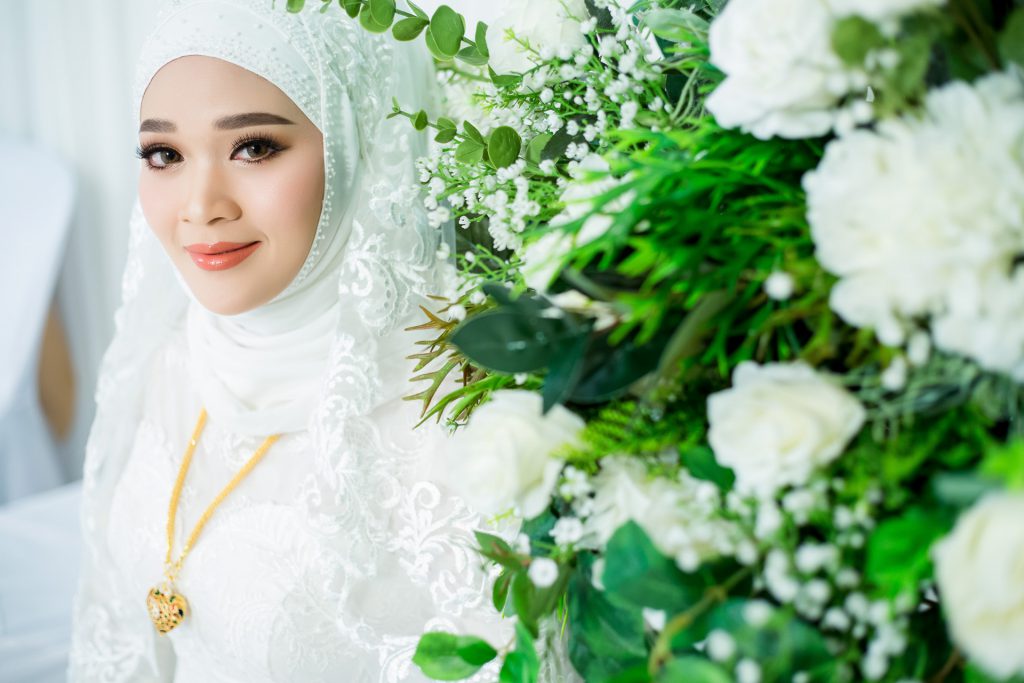
2. Understanding the nikah steps, or the Islamic wedding process, for a Buddhist bride
Once the bride-to-be has gotten past the first hurdle, the next thing is to gain a basic understanding of what the nikah steps, or the Islamic wedding process, actually look like, so as to understand the overall picture of what is and isn’t part of this religious ceremony. That said, the nikah steps in Thailand do vary somewhat, from slight to moderate, depending on local culture, but they share the same core elements. You can read more details on this here: What is Nikah? And How Is It Done? An Easy-to-Understand Guide
Now comes the next issue: Grandma wants a tea ceremony, the bride wants to cut a cake, can a Buddhist ceremony be held, how much of a betrothal-gift procession can be arranged? The details here tend to be fairly complex, with no fixed answer. If you’re starting to argue with your groom-to-be over this, don’t be impatient — there are ways to resolve these issues, and you’re not the only bride or groom stuck on this point.
If you’re stuck on this, you can ask our admin — there is a Nikah Planner service available, which includes advice and answers to the questions above and everything else about the nikah that may be troubling the bride and groom.
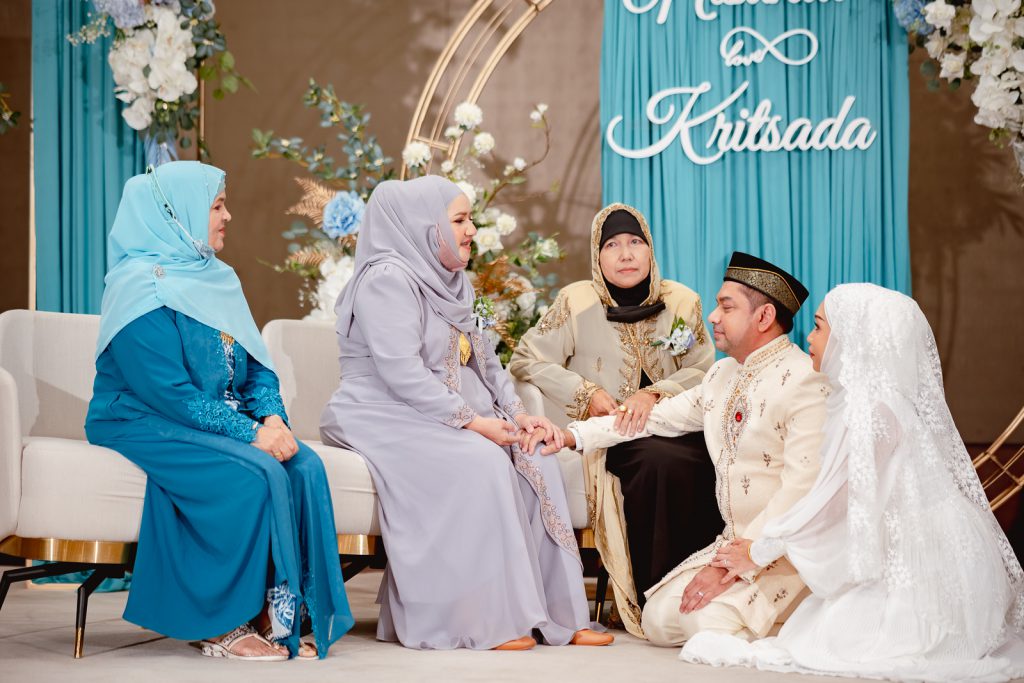
3. A Buddhist bride planning her learning and entry into Islam
Now comes the hardest part to come to terms with, and an important turning point for every Buddhist bride who will hold a nikah ceremony with a Muslim groom. No matter how ready the bride is to change, it’s still difficult. Changing religion creates many changes across many dimensions of life — both personal matters and family matters, adjustment, and daily life. Our admin and every senior bride who has gone through this are cheering on the newest bride-to-be through this part.
As already known from the previous section, the nikah has certain components, and one of them is that the couple are both Muslim, whether from birth or having converted before the wedding. Once one has entered Islam, that component is considered fulfilled.
Even though changing religion is a significant change that requires willpower to carry through, entering Islam itself turns out not to be as difficult as it seems — the process of entering Islam is actually much simpler, surprisingly so. Try reading this article: Entering Islam for New Muslims: An Easy-to-Understand Guide — the steps follow what’s described there.
That said, what matters is taking the time to adjust. In learning about Islam, the Araya team recommends not rushing — take it step by step. What’s important is that the groom-to-be, who is already Muslim, must learn alongside her — don’t leave her to learn alone. The word “learning” may sound formal, but it’s really social learning — through conversation, reading, asking teachers for more, or even enrolling in a full course. That part is up to you.
There is something worth being fairly careful about here, and this is a recommendation for the groom-to-be: learning about religion should not be rushed, but it does need a time frame. Balancing these two things is very important. Keeping the bride-to-be in a good atmosphere, with religious teaching that is friendly toward those interested or friends of other faiths, will make it easier for our bride-to-be to get through this part. Plan this part carefully, and don’t treat it too lightly.
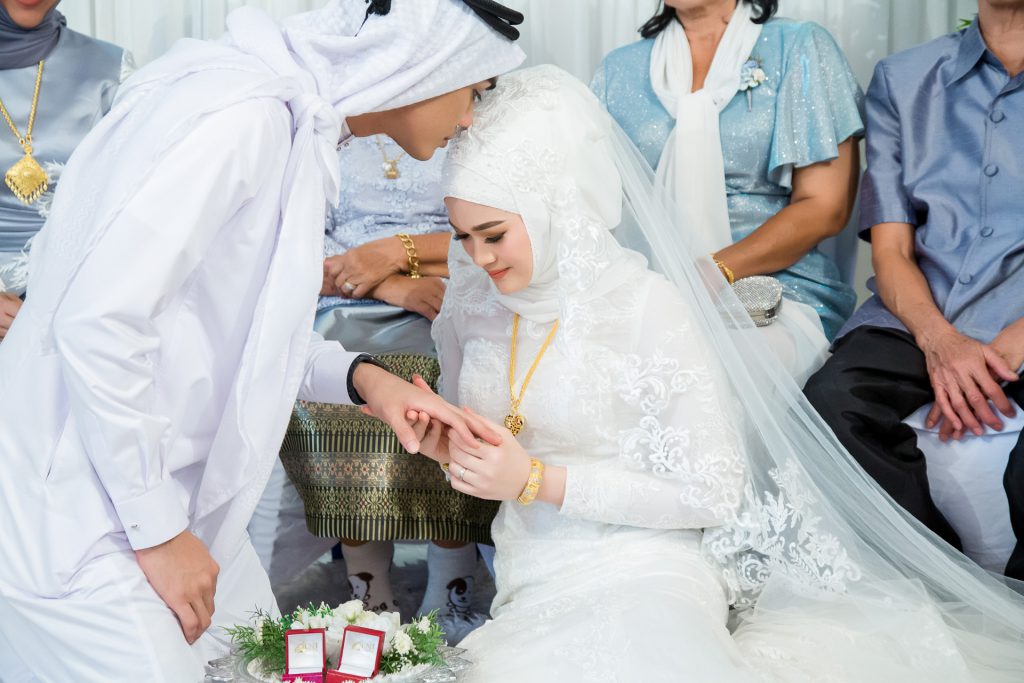
4. Communicate regularly with the Buddhist bride’s family
I believe both the Buddhist bride and the Muslim groom must face many obstacles before reaching the point of deciding to marry, especially one very common problem: resistance from elders in the family. Some couples face only minor friction, while for others it becomes a major issue, even leading to cutting off relatives and friends. I don’t want you to worry, but that is the reality that happens.
A common mistake is stopping communication when a problem arises, and stopping communication tends to turn a small problem into a much bigger one. What you really should do, I recommend, is that no matter what the conflict is, once the wedding preparation process begins, keep communication going — whether verbally or in person, such as dropping by for a visit, or sending Line stickers regularly — without needing to discuss anything complicated.
That said, if the couple wants a wedding that is truly meaningful and important, one that creates good things in married life, there are still steps to prepare in this area, including listening to important information (which sometimes needs to be filtered from unpleasant emotion), and using that information to design the sequence of steps in the nikah — including how to listen, how to speak, and what needs to be asked. This part is one part of the Workshop, or homework, in the Nikah Planner service, which can’t be fully covered here, since it’s quite long, complex, and differs from family to family.
But no matter what, hold on to the principle of listening and maintaining communication — that is the most important core of this step.

5. A Buddhist bride must plan the nikah systematically
Planning the nikah systematically is very important, and today it’s still a fairly new concept in Thai society. In the past, most brides and grooms tended to leave the burden of organizing the nikah to the elders, and what the elders would do next was procure an imam and organize the event following whatever format had been used before, which often led to many complicated problems, especially in cases where the imam did not understand religious differences.
Organizing the nikah systematically isn’t just about buying a wedding package or a nikah package — there is homework that the couple must do together with the team or organizer on many fronts, especially homework for the couple or family themselves, such as managing guests, managing food for guests, especially for those of other faiths — for example, how to handle it if there are vegetarian guests, what steps the nikah will include, when refreshments will be served, what the bride’s Buddhist father, mother, and grandmother need to do, which parts friends will help with, handling the dowry (sinsod), or who sits where during the nikah, and so on. If these questions aren’t settled clearly before the event begins, chaos and confusion will follow on the day itself.
At present, this body of knowledge has not yet been organized into a clear system in Thailand, which Araya keeps working to develop — covering consultation services, running the schedule or overseeing the day of the event, an online management system, or even various online consultation services for couples who want to organize things themselves. These are collectively called Nikah Planner.
That said, in cases where the couple organizes things themselves, what cannot be skipped is preparation and giving this the importance it deserves. I firmly believe that if the bride and groom follow these 5 recommended steps consistently, organizing a wedding for a couple from different-faith families will go smoothly for sure.
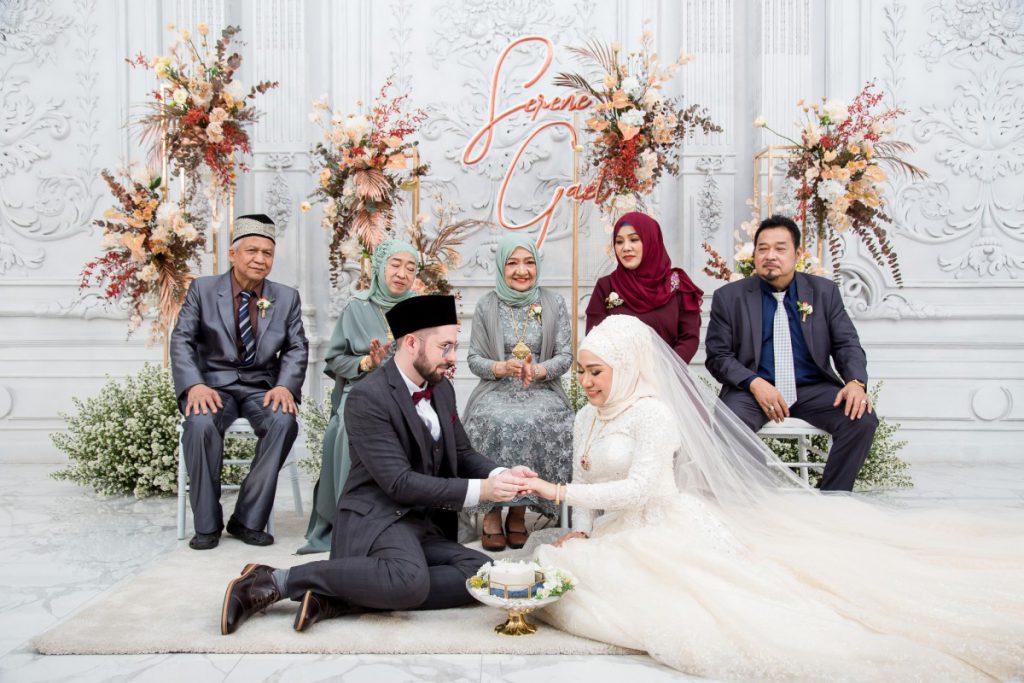
Closing Summary
A Buddhist bride marrying into Islam is both difficult and simple. But one thing the team can say for certain is that if the steps are followed correctly, your Islamic wedding will go smoothly. Most important of all is that you are not alone. Whenever you feel discouraged, click through to the team’s website — every couple pictured there is an interfaith couple just like you. The Araya Nikah Planner team is cheering on every Buddhist bride marrying into Islam, and we hope to see you at the next opening in the queue. We’re glad to be of service.
You must be logged in to post a comment.